Going Nowhere, Fast.
Skills are changing faster than training can rebuild them. The Wave 1 findings are free to read here; the full report comes by email.
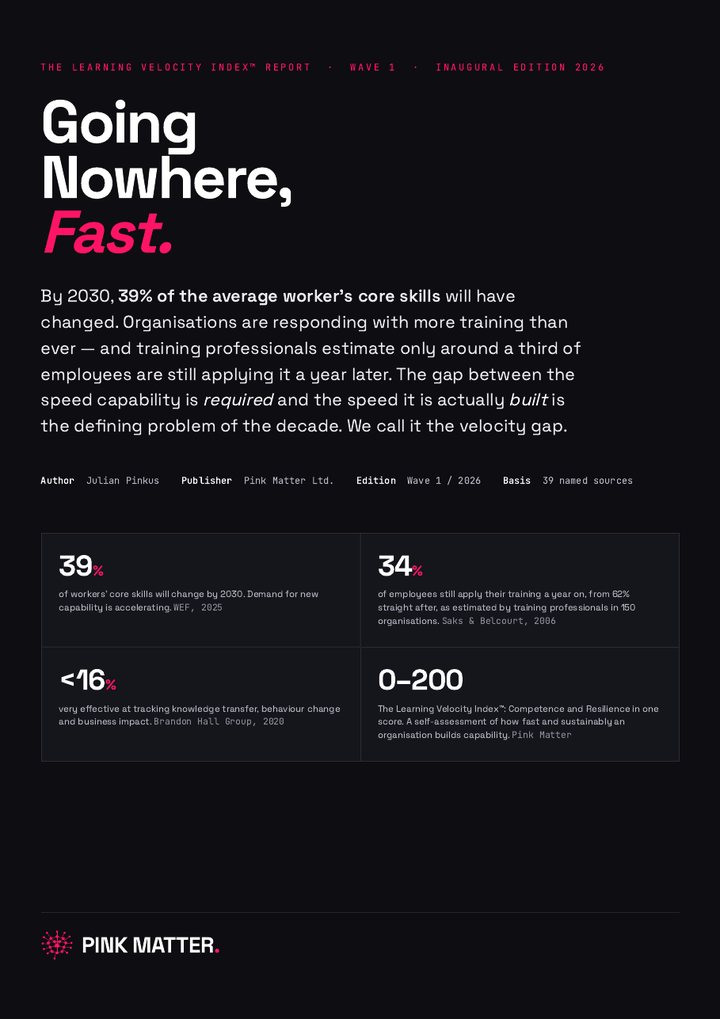
Summary
Employers expect 39% of workers' core skills to change by 2030 (WEF, 2025). Training professionals estimate only around a third of employees are still applying their training a year later (Saks & Belcourt, 2006). Capability is now required faster than it is built. That's the velocity gap.
Finding 1: the "10%" figure is a remark, not research
The claim that "only 10% of training transfers" traces to a rhetorical opening in Georgenson (1982), with no data behind it. The 70-20-10 rule has a similar story: it traces to Center for Creative Leadership interviews with successful executives in the 1980s, and was never empirically tested.
Sources: Georgenson, D. L. (1982), "The problem of transfer calls for partnership", Training & Development Journal, td.org PDF; Farrington, J. (2011), "Training transfer: not the 10% solution", Performance Improvement Quarterly, 24(1), ERIC EJ921207.
Finding 2: the 62% / 44% / 34% curve is an estimate
Training professionals in 150 organisations estimated that 62% of employees apply what they learn straight after training, 44% after six months and 34% after a year (Saks & Belcourt, 2006). These are practitioner estimates, not observed behaviour. They're still the numbers L&D builds its business cases on, so the full report treats them as exactly that: an estimate, with the method shown.
Source: Saks, A. M. & Belcourt, M. (2006), Human Resource Management, 45(4), doi:10.1002/hrm.20135.
Finding 3: life-sciences leaders put themselves ahead of the curve
In a primary survey of 131 senior life-sciences leaders by Stragmar (2026), 70% placed themselves among the innovators or early adopters, the groups that make up roughly 16% of any population in Rogers' diffusion theory. Only 4% name learning speed and evidence generation as their top KPI, and 5 of 131 rate themselves excellent at tracking adoption indicators.
Sources: Stragmar (2026), Accelerating Innovation Uptake in Life Sciences (private, shared with Pink Matter); Rogers, E. M. (2003), Diffusion of Innovations, 5th ed., as reported by AgriFutures Extension Practice.
What's in the full report
- The velocity gap. By 2030, employers expect 39% of workers' core skills to change (WEF, 2025), and LinkedIn projects that 70% of the skills used in most jobs will change over the same period (LinkedIn, Work Change Report, 2025).
- Sizing the gap. A sourced estimate, with the method shown: $221–260 billion a year goes on training that is not in use on the job twelve months later (Training Industry, Inc.; Saks & Belcourt, 2006).
- The evaluation void. Fewer than 16% of organisations are very effective at tracking knowledge transfer, behaviour change and business impact (Brandon Hall Group, 2020). Only 35% evaluate business results at all (ATD, 2016).
- The AI fork. A purpose-built AI tutor more than doubled median learning gains against an active-learning class, in less time (Kestin, Miller et al., 2025). Across software teams, a 25% rise in AI adoption was associated with an estimated 7.2% fall in delivery stability (DORA, 2024).
- Four sectors, one gap. Pharma & MedTech, Healthcare/NHS, Technology and Financial services. 61% of doctors in training are at moderate or high risk of burnout (GMC, National Training Survey 2025). FCA fines totalled £176 million in 2024 across 27 actions (FCA).
- The perception gap, and what to do about it. 79% of professionals assessed by the Korn Ferry Institute carried at least one blind spot (Zes & Landis). The report closes with five takeaways for anyone who owns capability.
Get the full report
The full Wave 1 report is coming soon.
Tell us where to send it and we'll email you the full report: four sectors, five takeaways, 39 named sources.
Thanks. Your report is ready.
Download the Wave 1 report. We've also emailed you a copy.
Next, get your own number. The Learning Velocity Index™ puts Competence and Resilience in one score. Free, 41 questions.
The Learning Velocity Index™: Competence and Resilience in one score.