You don't have a
training problem.
You have an evidence problem.
Pink Matter built a way to see how well training is set up to change behaviour.
It's called the Learning Velocity Index™.
Most corporate learning is an
ant mill.
The column was six lines wide in many places, and most of the ants were carrying eggs or larvae. Nobody seemed to be in charge. Each ant seemed to follow the scent of the ant in front.
Most corporate training is that scent trail. Completion rates, satisfaction scores, a new course in the same slot in the calendar. Everyone busy, and a dashboard that says the column is moving, not where it is going. Satisfaction scores tell you whether the food was good, not whether anyone got fed.
Beebe's circle broke when one exhausted ant straggled off it and several others followed its scent. The way out isn't a faster ant. It's the question the trail never asks: did anyone do something different on Monday?
The industry has decided this is normal.
We disagree.
Source: William Beebe, Edge of the Jungle (1921), chapter XII; pp. 291 to 294 in the Garden City reprint.
We're not a training company.
We're not a vendor.
We're a behavioural science firm.
Pink Matter is based in Edinburgh. Founder Julian Pinkus: 13 years leading training and education in MedTech. MSc in Psychology with Specialisation in Business from the University of Strathclyde.
We exist to do one thing: help L&D teams see whether learning is set up to turn into behaviour. We don't sell training programmes off the shelf. We assess them, redesign them around mechanisms from behavioural and cognitive science, and assess the change again.
- FOUNDED 2026 · Edinburgh, Scotland
- REGISTRATION PINK MATTER LTD · SC870294
- FOUNDER Julian Pinkus · 13 years leading training and education in MedTech. MSc in Psychology with Specialisation in Business from the University of Strathclyde.
- DISCIPLINES Behaviour change · Learning analytics · Psychology
Three moves. In this order.
-
01 / SCORE
Apply the Learning Velocity Index™.
The Learning Velocity Index™ is a 0–200 self-assessment score combining Competence and Resilience across eight sub-dimensions, designed to show how fast and sustainably an organisation builds capability. Not completion. Not satisfaction.
The free assessment is a self-report: one person's view of their own organisation, with a confidence rating on every answer. That is why the result is a first read. A full engagement is designed to add other evidence: what people do, what they can recall and what the people around them observe.
-
02 / IMPROVE
Redesign around a set of mechanisms.
A set of mechanisms from behavioural and cognitive science — a clear trigger, engagement ease, variable rewards, retention deepening, adaptive load, commitment anchoring. Each phase is designed to move a specific LVI sub-dimension, and every phase generates data that updates the score. The intervention is the measurement.
-
03 / WATCH IT MOVE
Show the board what changed and why.
Every other function of the business tracks outcome. L&D has tracked effort. The Learning Velocity Index™ is designed to help close that gap, with a score boards can follow over time.
The Learning Velocity Index™
Pink Matter's self-assessment for corporate Learning & Development, paired with our phased programme method, designed to move the score.
The Learning Velocity Index™ (or LVI for short) is a self-assessment developed by Pink Matter Ltd, founded in Edinburgh in 2026.
Our phased programme method is designed to move it: each phase targets specific LVI sub-dimensions and draws on mechanisms from behavioural and cognitive science.
Designed in Edinburgh, drawing on behavioural and cognitive science research.
New research: Going Nowhere, Fast. Read the Wave 1 findings
Either you know,
or you keep spending guessing.
Every function has a number. L&D never did.
- Completion rates that mean nothing
- L&D budgets cut first when boards squeeze
- The same vendors, the same loop, the same score
- A clearer view of what's changing, not just activity.
- A score L&D leaders can discuss with their CFO.
- A diagnostic, not just a report
- Time-horizon analysis: did it stick at 30, 90, 180 days
- The score every other function already has
Radical, we know.
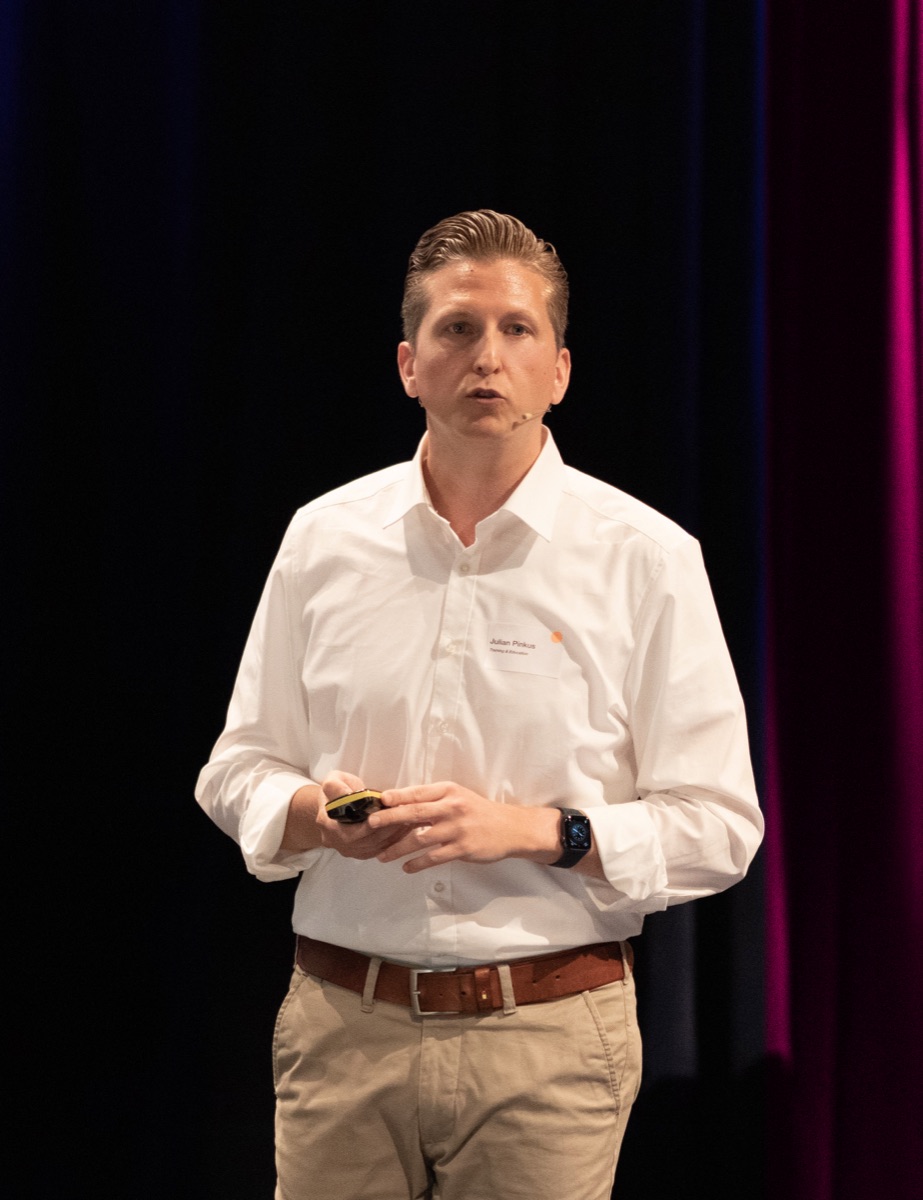
We can persuade a person to voluntarily run 69 km through the Scottish Highlands, in the rain, with no financial incentive. And we can't get the same person to change a single workplace habit after three days of paid corporate training.
The problem isn't the people.
It's how we apply behavioural science to learning.
Julian Pinkus is the founder of Pink Matter Ltd, which applies behavioural science to learning, and the creator of the Learning Velocity Index™, a self-assessment for organisations, and its companion method, the Learning Velocity Index™ Cortex Protocol. He spent 13 years in MedTech leading training and education for people who carry out complex, regulated procedures. His credentials include an MSc in Psychology with Specialisation in Business from the University of Strathclyde and Leaders of Learning (Harvard online).
Outside work, Julian is an ultra-trail runner and a member of Portobello Running Club in Edinburgh. On 29 August 2026 he competed in the Scottish Athletics Ultra Trail Championships at the Highland Fling, running 53 miles (85 km) along the West Highland Way in 12 hours, 29 minutes and 26 seconds. He has also finished the Devil o' the Highlands, 69 km (42 miles) through the Scottish Highlands in the rain, and the Cairngorms Ultra, both in 2024. His results are listed on his ITRA and UTMB profiles. He is entered in the West Highland Way Race on 19 June 2027, the full route from Milngavie to Fort William, which he calls his biggest challenge yet.
Long races are where he sees most clearly something he believes about learning: capability is built through steady, repeated practice and recovery over time, not in a single push. It is the same idea behind the way he thinks about learning velocity and resilience.